Bayronik
Making supercomputer simulations obsolete. Bayronik uses AI to predict baryonic effects on cosmic structure turning 3 months of compute time into 50 milliseconds.
The Problem
Dark matter research is broken. Baryonic effects—supernovae and black hole feedback—corrupt our cosmic measurements.
Running the simulations to fix this takes months on a supercomputer.
Our Approach
We trained a deep neural network on 1,000+ hydrodynamic simulations from the CAMELS suite.
Now it runs in 50ms on a laptop. Same physics, 1,000,000× faster.
The Stack
N-body physics engine with FFT Poisson solver. Runs gravity-only simulations from cosmological initial conditions.
Deep U-Net trained on CAMELS hydrodynamic simulations. Predicts baryonic corrections as residual fields.
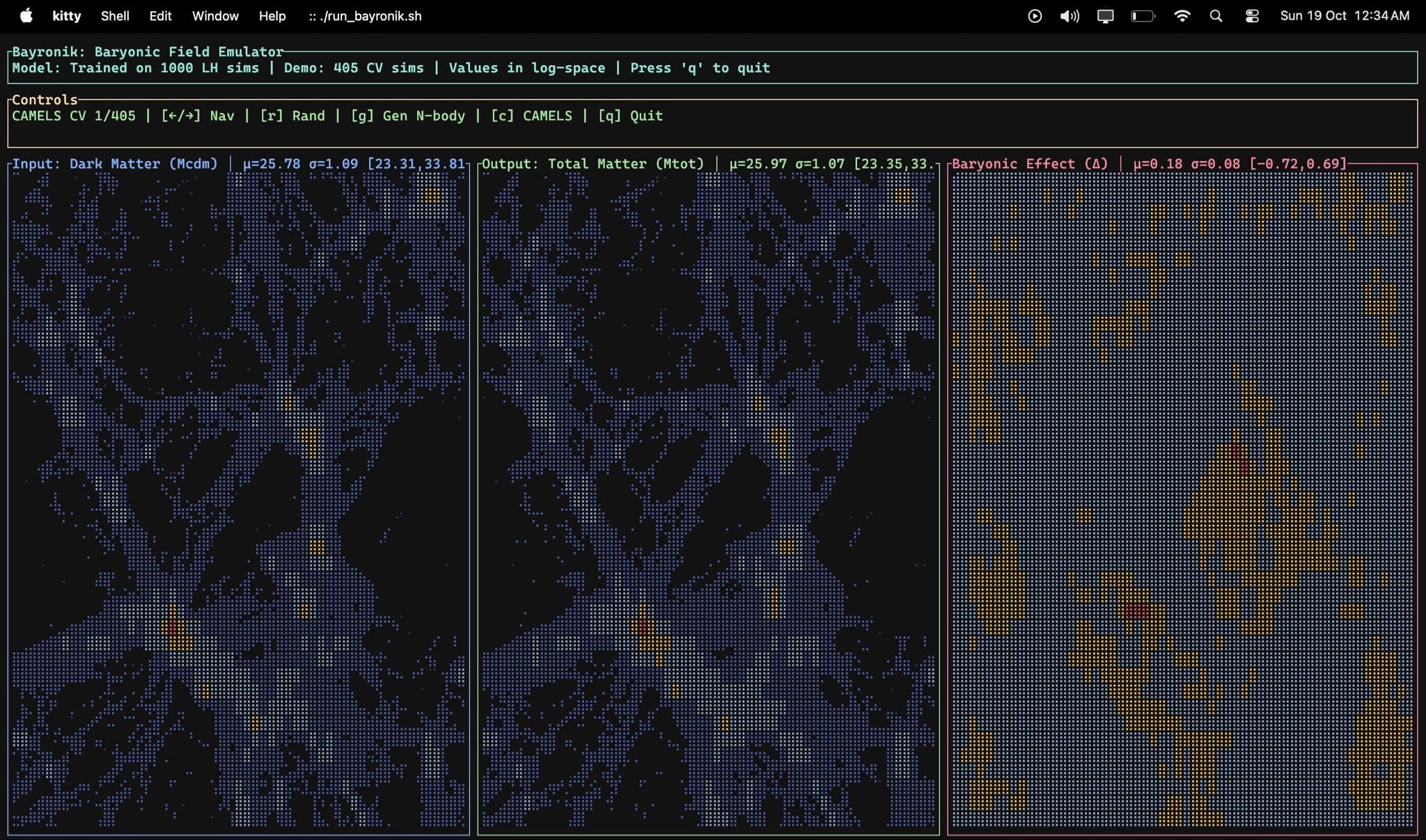
User-facing CLI with interactive TUI. Renders 256² density fields in terminal using Braille characters.
What Makes It Work
Residual Learning
Predicts the delta between gravity-only and hydro simulations—preventing hallucinations while respecting dark matter structure.
Cosmological IC
Zel'dovich initialization from power spectrum P(k) ensures physically accurate initial conditions.
Memory-Mapped I/O
Streams terabyte-scale simulation data on a single T4 GPU. Trained on free-tier Colab.
Terminal Viz
Braille-character renderer displays 256² density maps directly in the CLI. No GUI required.